
How Does a Plane Actually Fly?
A beginner's guide to aerospace
You've probably looked up at the sky and watched a plane cut through the clouds — a 500-tonne metal tube somehow defying gravity at 900 kilometres per hour. And maybe, like most people, you just accepted it as one of those things that "science figured out." But here's the thing: the principles behind flight aren't just textbook material. They're genuinely fascinating — and once you understand them, you'll never look at a plane (or even a paper dart) the same way again.
The Four Forces of Flight
Let's take a closer look..
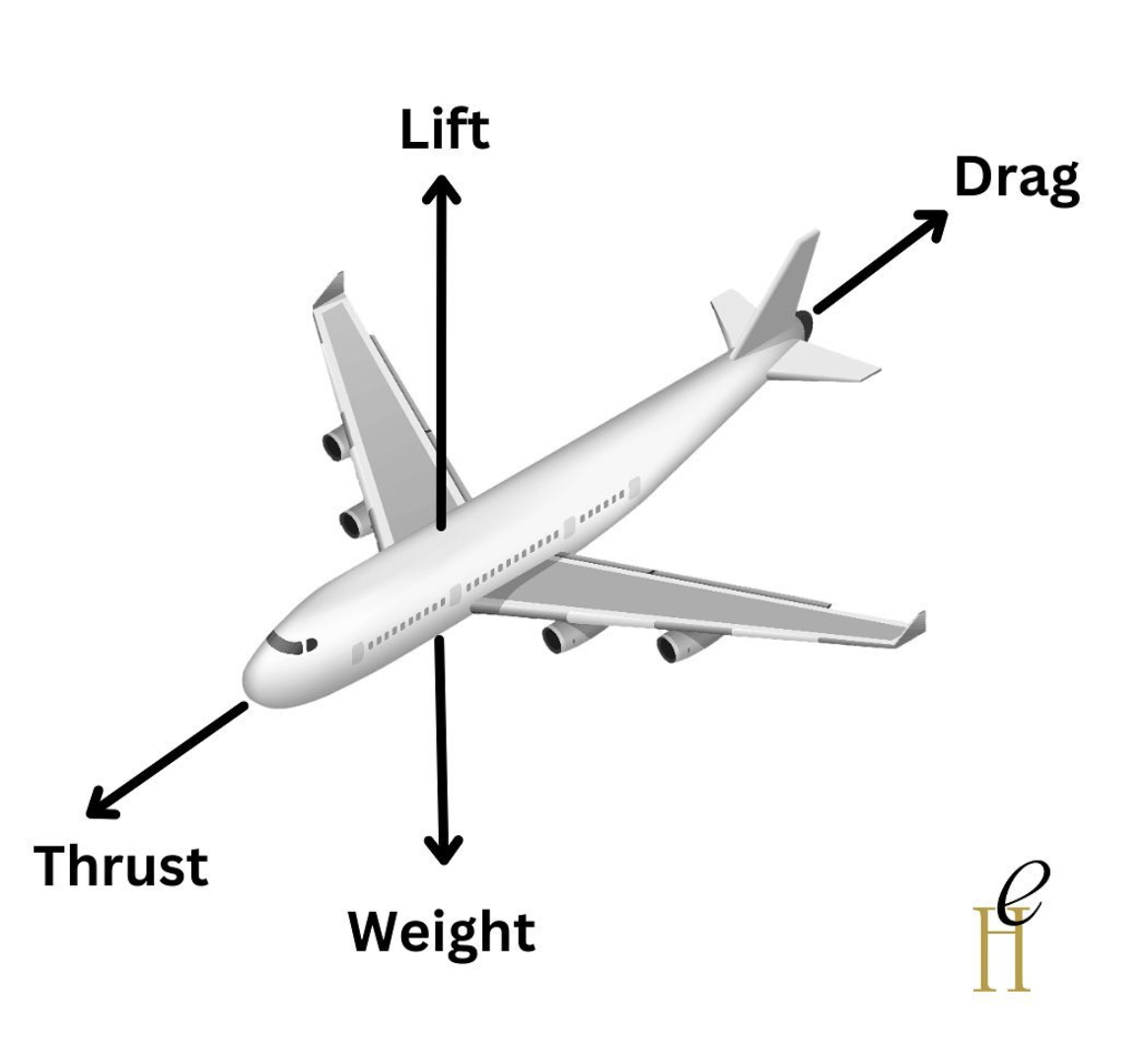
Every aircraft in the sky is caught in a constant tug-of-war between four forces. Master these four, and you've got the foundation of aerodynamics.
1. Lift — the upward force that gets the plane off the ground
2. Weight — gravity pulling the aircraft down
3. Thrust — the forward force generated by the engines
4. Drag — air resistance pushing back against the aircraft
For a plane to fly level, lift must equal weight, and thrust must equal drag.
Simple in theory. Extraordinary in practice!
For stable level flight: Lift =Weight
For climbing: Lift > Weight
For descending: Lift < Weight
So How Does Lift Actually Work?
Bernoulli's Principle
This is where it gets interesting & where a lot of school textbooks oversimplify things.
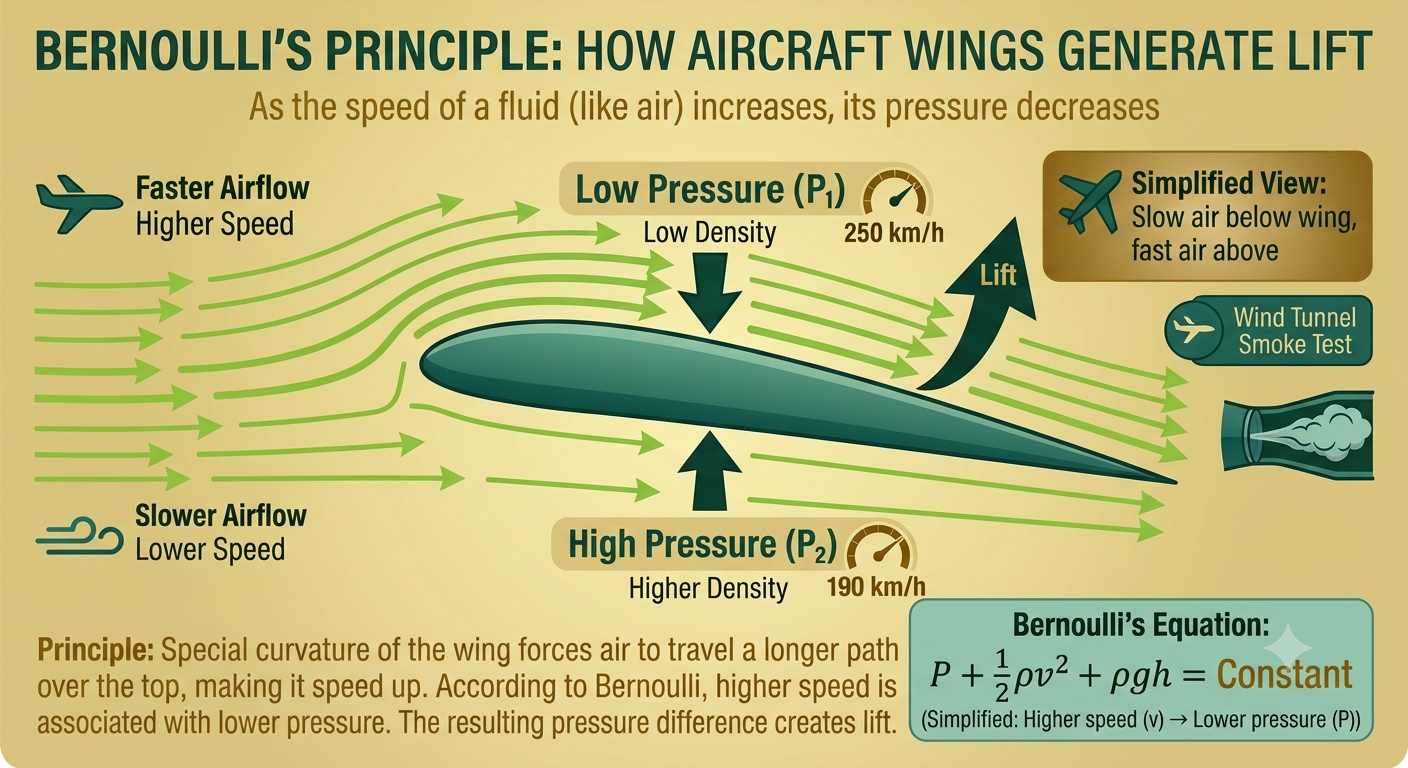
The wing is the hero of the story. Wings are shaped with a special cross-section called an aerofoil (or airfoil). The top surface is curved, while the bottom is flatter. When the wing moves through air, two things happen:
1. Air moving over the curved top surface has to travel a longer path causing it to speeds up.
2. Air moving under the flatter bottom surface travels a shorter path causing it to slow down.
Bernoulli's Principle states that as the speed of a moving fluid increases, the pressure within that fluid decreases.
So the faster moving air creates lower pressure & slower moving air creates higher pressure. That pressure difference: high pressure below, low pressure above, generates an upward force which is called the lift.
What else helps create Lift?
Angle of Attack (AoA)
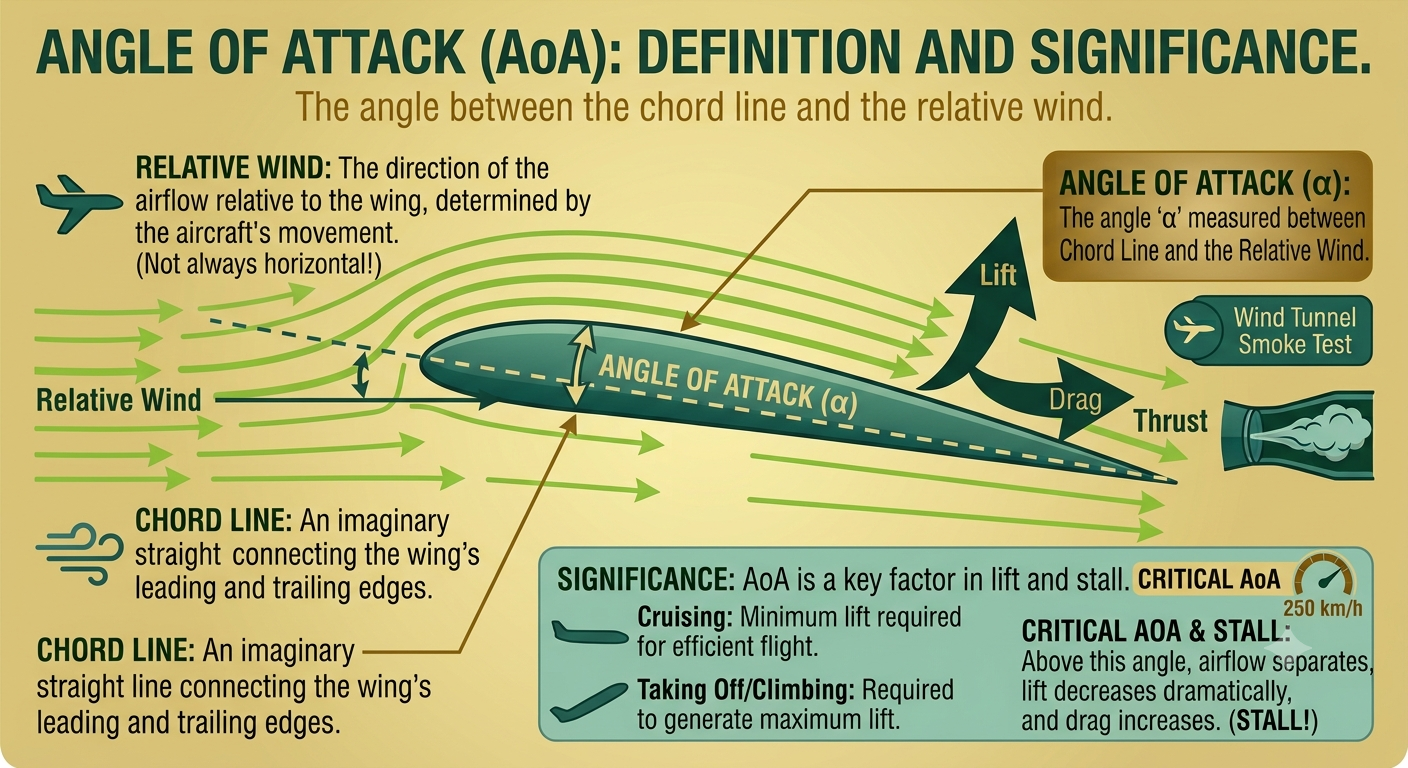
Bernoulli isn't the whole story. Wings are also tilted at a slight angle into the airflow, this is called the Angle of Attack (AoA): the angle measured between the wing's chord line (an imaginary straight line connecting the wing's leading and trailing edges) and the relative wind (the direction of airflow relative to the wing, determined by the aircraft's movement).
This tilt causes the wing to physically deflect air downward, and by Newton's Third Law; "for every action, there is an equal and opposite reaction", the wing gets pushed upward. Both Bernoulli's Principle and the angle of attack work together to generate lift.
The AoA also changes depending on what the aircraft is doing. During cruising, a lower angle provides the minimum lift needed for efficient flight. During takeoff or climbing, a higher angle is used to generate maximum lift.
But there's a limit. Exceed the critical angle of attack and the smooth airflow over the wing breaks apart entirely, lift drops dramatically, drag surges, and the wing stalls. It's one of the most important concepts in aviation safety.
The truth is: lift is more complex than any single equation, and aerodynamicists still study it. That's part of what makes aerospace engineering so rich as a field.
What about Thrust & Drag?
Thrust
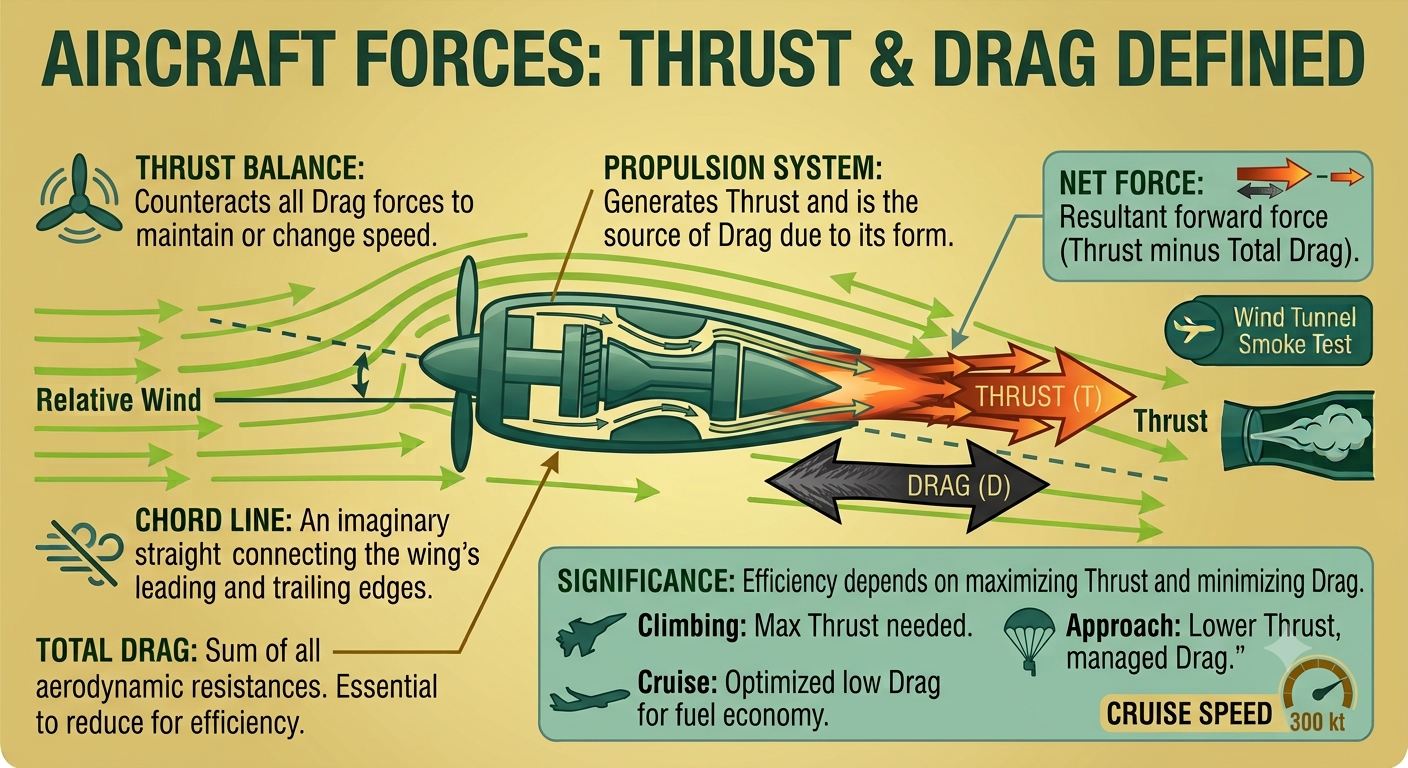
Thrust is what moves the aircraft forward. Commercial jets use turbofan engines — massive fans at the front that suck in air, compress it, mix it with fuel, ignite it, and blast exhaust out the back. The reaction to that exhaust pushes the plane forward..
Drag
Drag is the enemy of efficiency. It's the resistance the aircraft faces as it pushes through air. Engineers spend enormous effort shaping every part of an aircraft — the fuselage, engine nacelles, even the winglets at the tips of wings — to reduce drag. Those upturned wing tips you see on modern planes? They reduce a particularly wasteful form of drag called induced drag, improving fuel efficiency by several percent. That small design choice saves airlines millions in fuel every year..
The aerodynamics of an RC plane at AeroDay and a commercial airliner at 35,000 feet are governed by the exact same principles. The scale changes. The materials change. The complexity increases dramatically. But lift, drag, thrust, and weight are universal. When students build and fly RC aircraft, they aren't just doing a fun activity, they're experiencing real aerospace engineering in their hands.. Understanding aerodynamics opens a door. It's the first step toward understanding why aerospace engineering exists as a discipline and why people dedicate careers to perfecting the shape of a wing by fractions of a millimetre. With a growing generation of students with serious technical ability and global ambitions, Aerospace is a field where that talent can go far, whether that means studying engineering in Germany, working in aviation, or contributing to the space industry that is rapidly expanding across Asia and beyond. The sky, as they say, is not the limit. It's just the beginning.
We connects curious students with the knowledge, mentorship, and pathways they need to turn big ambitions into real careers.
If you have a topic you'd like us to cover, get in touch! We'd love to hear from you!
Lorem ipsum dolor sit amet, consectetur adipiscing elit. Ut elit tellus, luctus nec ullamcorper mattis, pulvinar dapibus leo.